
Category: Innovation and R&D
Quick answer
A professional haircare formula begins by translating a need into specific objectives: what the product should do, which hair types it is intended for and how it will be used. Ingredients are then selected, prototypes are compared and the proposal is assessed to determine whether it can become a stable, safe and consistently reproducible product.
Before a hair mask reaches the salon, someone has had to answer a seemingly simple question: what do we want to improve in the experience of the professional and their client?
The answer guides the entire haircare formulation process. From texture to packaging, every decision should contribute to a shared objective. To understand how this works, we can follow an example: a hair mask designed to make detangling easier while leaving a lightweight finish.
From idea to product in six stages
- Define: establish the need, the target user and the application method.
- Design: select ingredients and develop the initial formula.
- Compare: prepare prototypes and assess their differences.
- Assess: study performance, stability, safety and packaging.
- Scale up: adapt the process to industrial manufacturing.
- Prepare for launch: complete checks, documentation and directions for use.
These stages are interconnected: an unexpected result may require revisiting the formula or reviewing the original concept.
1. The concept becomes a product brief
The first step is to describe precisely the product to be developed. The brief brings together the requirements that will guide the team’s work.
For our illustrative hair mask, saying “we want softness” would not be enough. The team would need to specify the hair type, processing time, frequency of use and expected finish.
- Will it be applied to fine, thick, colour-treated or bleached hair?
- How important are detangling and a lightweight feel?
- How should it be dispensed and rinsed out?
- What format and positioning will it have within the range?
The clearer the starting point, the more useful the comparison between proposals will be.
2. Ingredients are chosen for their role in the overall formula
Formulation involves deciding how ingredients should work together. Selection is guided by the desired result, compatibility and conditions of use.
In our hair mask example, the team would need to balance conditioning with texture, distribution and rinsing. Making one characteristic more pronounced does not automatically improve the product: a richer feel could move it away from the intended lightweight finish.
The value of a formula lies in how well the complete product meets the objective it was designed for.
3. Prototypes support decision-making
The concept starts to take shape when samples are compared. One proposal may spread more easily; another may rinse out more readily or leave a different feel after drying.
For this comparison to be useful, application conditions should be clearly defined and kept consistent. In our example, changing the amount applied, the processing time and the hair type simultaneously would make it difficult to interpret the differences.
The work of the R&D department helps turn these observations into formulation adjustments.
4. Performance must hold up beyond the first application
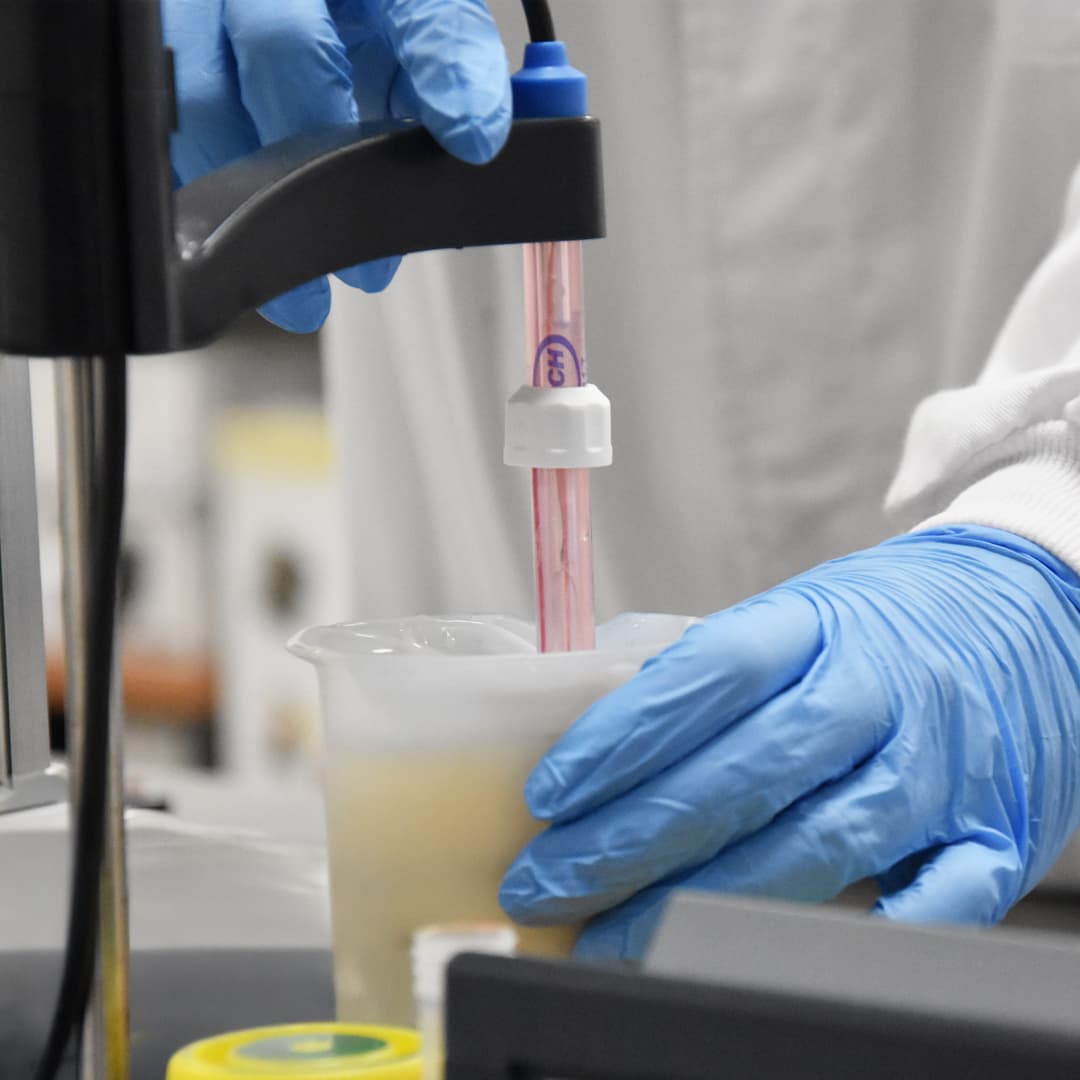
A promising sample needs a broader assessment. Its stability, microbiological quality and interaction with the packaging are studied according to the product’s characteristics.
Packaging is also part of development: it must allow the formula to be dispensed and used correctly. A texture suitable for a jar may be impractical in another dispensing system.
Product benefits must also be supported by adequate evidence. An objective set out in the brief does not, on its own, become a substantiated claim.
You can explore this topic further in our article on the checks a cosmetic product undergoes before reaching the market.
5. The formula is adapted to industrial manufacturing
Scale-up transfers development from the laboratory to production. It requires adapting the process to manufacturing equipment and production volumes.
The order in which ingredients are added, mixing conditions and temperatures must be defined to reproduce the approved characteristics. The aim is for the formula to retain its behaviour when manufactured on a larger scale.
6. The product is prepared for professional use
Development culminates when the formula, manufacturing process and directions for use are aligned. Before a product is marketed in the European Union, applicable safety, documentation, labelling and notification requirements must be met.
The product also needs to be explained clearly: who it is for, how much to apply and how to incorporate it into a salon service. For our hair mask, these instructions would help the professional achieve the intended finish.
Frequently asked questions about haircare formulation
How long does it take to develop a haircare formula?
There is no single timeframe. It depends on the starting point, product complexity, necessary adjustments and planned testing. The schedule should allow for possible reformulation.
Why might a formula change during development?
Because testing may show that its texture, application, stability or behaviour with the packaging does not meet the original objective.
Is packaging chosen at the end?
It should be considered during development, as it affects product protection, dispensing and the user experience.
An idea becomes a product through a series of decisions
Developing haircare products requires connecting salon needs with what can be formulated, assessed and manufactured. The quality of the project depends on those decisions maintaining a shared objective from the initial concept to the finished product.
Verified sources
Haircare specialists, quality manufacturers
At Global Cosmetic Technology, we develop and manufacture professional haircare products in Valencia, combining technical knowledge with industry experience.
Contact our team to learn more about our brands and our work.